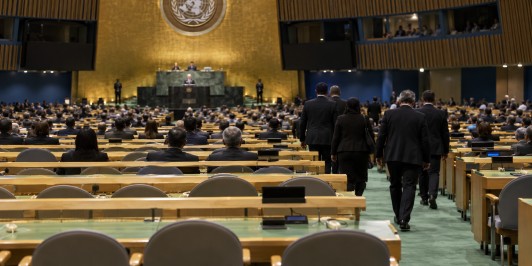
During the United Nations General Assembly in New York, tensions escalated as representatives from Iran and Cuba exited the chamber in response to critical remarks by U.S. President Donald Trump. The speech, delivered on September 22, addressed various international issues, with Trump’s comments on Iran and Cuba prompting walkouts from their respective delegations.
The Iranian delegation left the assembly when Trump discussed the United States’ military operations against Iran. He highlighted the U.S.’s stance of possibly taking further action should no agreement be reached with Tehran. Iranian President Masoud Pezeshkian and Foreign Minister Abbas Araghchi were in New York for the assembly, although they were not present during Trump’s address.
Trump emphasized that the U.S. faced a pivotal decision between negotiating a deal with Iran or pursuing additional measures against the nation. He further called on other countries to amplify economic pressures on Tehran, underscoring the administration’s hardline approach towards the Islamic Republic.
Later, the Cuban delegation also departed from the chamber following Trump’s description of Cuba as a “failed state.” He asserted that his administration was pursuing fundamental changes on the island and declared that freedom would ultimately come to Cuba. Additionally, Trump warned against allowing foreign adversaries to establish a foothold there, reiterating his administration’s firm policy towards the Cuban government.
These walkouts underscored the contentious nature of Trump’s speech, which outlined the U.S. administration’s foreign policy positions. As world leaders convened at the UN General Assembly, Trump’s comments on Iran and Cuba drew significant attention and sparked direct reactions from the delegations concerned.